Start with the rig, not the silhouette
A harbor full of old sailing vessels can look like a forest of masts. The simplest way to sort them is to look past the hull and ask three questions: How many masts are there? Which sails are set across the vessel? Which run roughly along its length? A vessel’s rig is the arrangement of its masts, spars and sails. Many familiar names, including brig and schooner, describe that arrangement more precisely than they describe the hull.
Square sails hang from horizontal spars called yards and face broadly across the vessel. Fore-and-aft sails run more nearly from bow to stern; a mainsail with its leading edge attached to a mast is a common example. A rig can combine both kinds. When viewing a vessel from shore, look at the spars even if the sails are furled: several yards crossing a mast suggest square rigging, while a long boom projecting aft suggests a fore-and-aft sail.
One mast: sloop and cutter
On a typical one-masted sloop, a mainsail sits behind the mast and one headsail sets ahead of it. A cutter also has one mast but is commonly distinguished by its capacity to set more than one headsail, often using both an inner stay and an outer stay. If the sails are down, those stays can be difficult to pick out against a busy background. Count the sails and their attachment points when you can, rather than relying on the hull’s shape.
These labels need context. Historic working boats were adapted to local waters and tasks, and “cutter” has also been used for certain boats and service vessels without referring solely to a textbook sail plan. If a museum or crew uses a regional name, keep it alongside the rig description. “One-masted boat with a cutter rig” may tell you more than trying to force every vessel into a single category.
Two masts: schooner, brig and brigantine
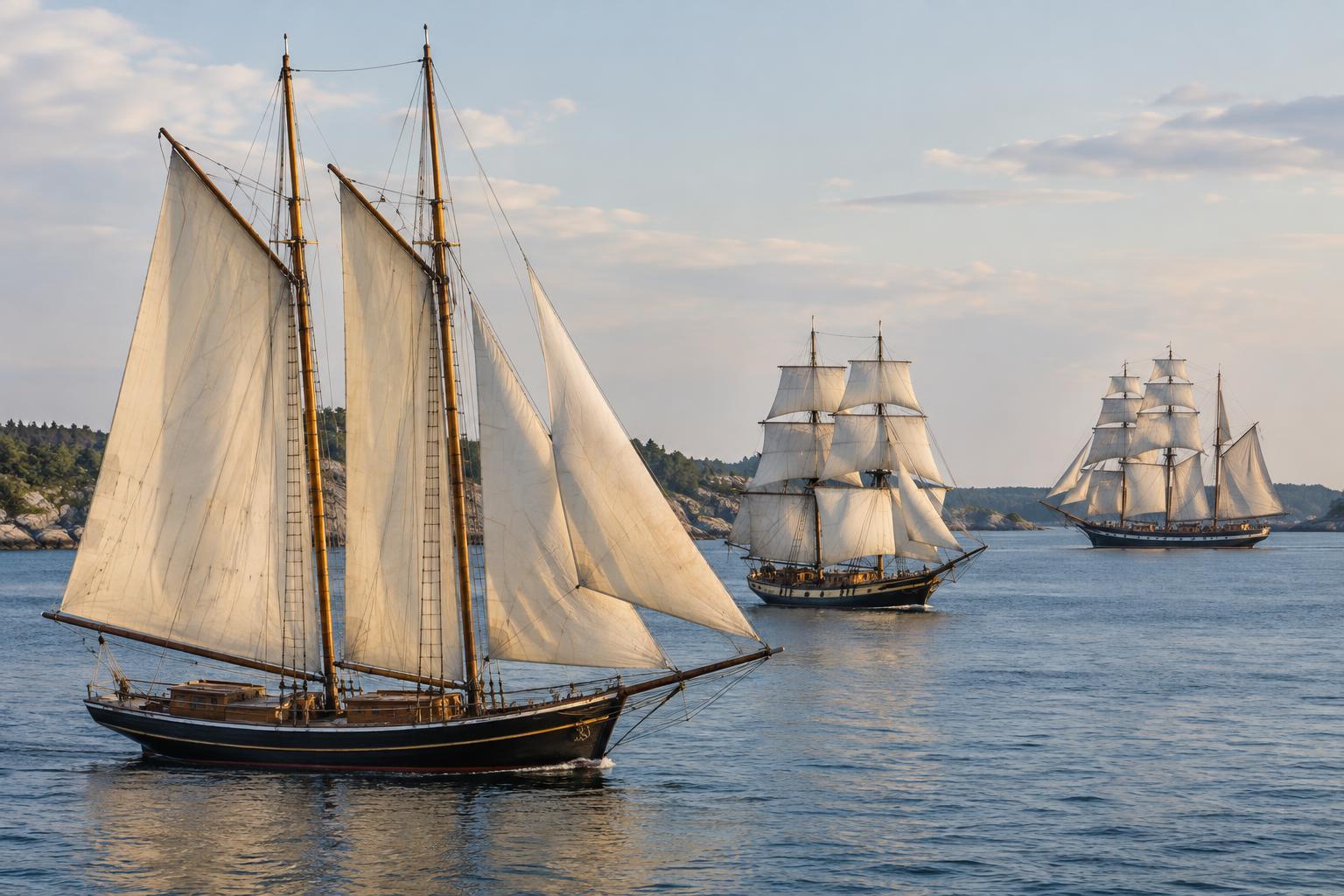
For two-masted vessels, first compare the sails on the forward and aft masts. A schooner is primarily fore-and-aft rigged; its aft mast is generally as tall as, or taller than, the forward one. Some schooners also carry square topsails, so a few yards aloft do not automatically rule out the name. From a distance, look for the dominant sail plan rather than one isolated sail.
A brig has two masts square-rigged on both. Rows of yards on each mast are its most useful visual clue. A brigantine generally has square sails on the forward mast and fore-and-aft sails on the mainmast behind it. Historic usage was not perfectly uniform, especially as rigs changed over a vessel’s working life. If you are unsure, describing what you see—“two masts, square sails forward and a fore-and-aft mainsail”—is both useful and honest.
Three or more masts: ship, barque and barquentine
With three or more masts, check the aftmost mast. A full-rigged ship carries square sails on all its masts. A barque carries square sails on its forward masts but is fore-and-aft rigged on the last one. A barquentine has square sails on the foremost mast and fore-and-aft sails on the remaining masts. These patterns make the aft end of the vessel particularly helpful when you are trying to identify it from a quay.
“Ship” also has a broad everyday meaning, so a vessel called a ship in conversation is not necessarily full-rigged. Conversely, the precise rig name may be hard to establish when sails are missing or a preserved vessel has been altered. Count the masts and identify where the yards are before settling on a label.
Look closely, then leave room for local history
Not every two-masted craft is a schooner, brig or brigantine. Ketches and yawls are primarily fore-and-aft rigged and have a smaller mizzen mast behind the mainmast. The conventional distinction places a ketch’s mizzen forward of the rudder post and a yawl’s aft of it. That point may be invisible from shore, so it is wiser to consult the vessel’s information board than to guess from the mizzen’s size alone.
A good harbor habit is to make a short observation before reading the nameplate: count masts, note which carry yards, and look for headsails and booms. Then compare your impression with the vessel’s recorded identity. Local boat types may be named for a place, trade or hull form as well as for their rig. Learning those names adds something a classification chart cannot: a sense of how people shaped boats for the waters and work around them.