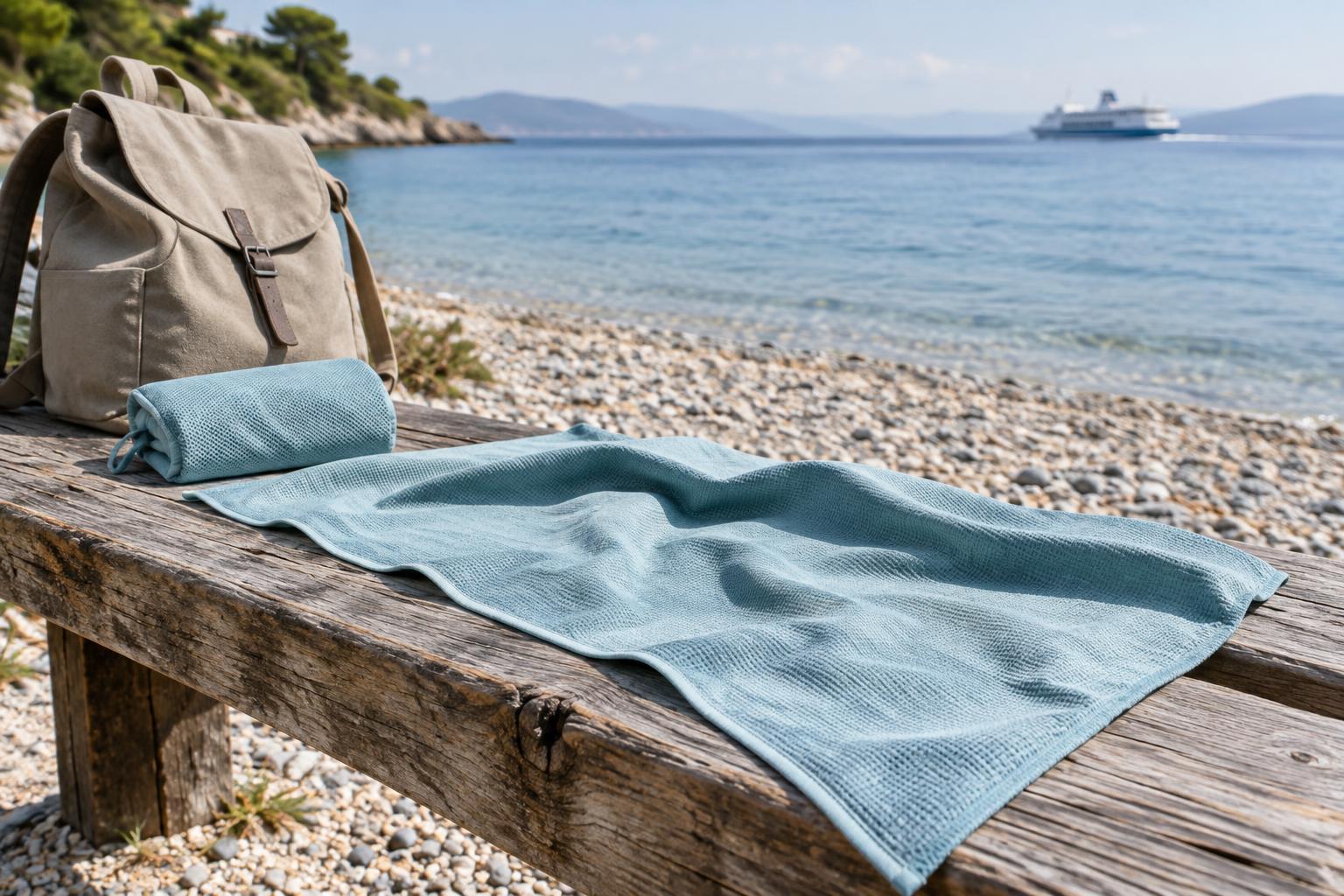
Start with how you will use it
A travel towel has to do more than fit in a bag. On a coastal trip, it might dry you after a swim, sit between you and a pebbly beach, or hang overnight in a room with little airflow. Before comparing fabrics, decide which of those jobs matters most. A compact towel for occasional dips can be quite different from the one you want to use after every shower.
Think about the time between packing and unpacking, too. If you can spread a towel out for several hours, softness and size may be your priorities. If you often leave early for a ferry or change accommodation, a towel that releases moisture quickly may be worth a less plush feel. No fabric stays pleasantly dry when it is stuffed wet into a sealed bag for long.
Compare fabrics by feel as well as drying time
Synthetic microfiber towels, commonly made from polyester or nylon, are popular because they fold small and generally dry faster than a thick cotton bath towel. Their smooth, thin texture can feel unfamiliar: many work best when pressed against the skin rather than rubbed. They may also cling to sand or pick up odors if left damp. Check the care label, since construction and finishes vary between towels.
Cotton is familiar and absorbent, but a thick cotton towel takes up room and can be slow to dry in humid air. A lightweight woven cotton towel offers a different compromise: less bulk than terry cloth and a comfortable surface for sitting, though it may not feel as cushioned after a shower. Linen and cotton-linen towels can also pack relatively flat. Their texture tends to soften with use, but some travelers find it rough at first.
There is no universally best material. If skin feel matters more than the smallest possible bundle, consider a lightweight natural-fiber option. If you need to pack soon after each use, a thin quick-dry synthetic may be easier to manage. Whenever possible, feel the fabric and look at its thickness rather than relying on a “quick-dry” label alone.
Choose a size that earns its space
A small towel is useful for hands, hair or a brief swim, but it may be frustrating as your only towel. A medium size often covers the basics of drying off while remaining easy to hang from a rail or clothesline. A larger towel gives more coverage for changing and more space to sit on, at the cost of extra bulk and a longer drying time. Compare the towel’s open dimensions with one you already use at home; photographs of folded towels can be misleading.
Consider the places you expect to stop. On a sandy shore, enough length to sit comfortably may matter more than full-body coverage. On a boat or in shared accommodation, a modestly sized towel is easier to keep clear of other people’s belongings. If one towel cannot comfortably handle both bathing and beach use, a small second cloth may be more practical than one oversized towel that is always damp.
Look for useful details, not just a small pouch
A hanging loop can make a noticeable difference when hooks are scarce. A pouch is handy for keeping a clean towel together with your kit, but it is not a substitute for drying it. If the pouch has a mesh panel, air may circulate more freely than in a fully closed bag, though you should still take the towel out when you can.
Check seams and edges for a finish that looks secure, especially on thin fabrics that will be washed often. Color is a practical choice as well as a personal one: a distinctive towel is easier to spot among similar gear, while a darker shade may hide marks between washes. None of these details needs to outweigh the basics of size, feel and drying space.
Care for it between stops
After use, rinse away salt or sand when clean water is available, then squeeze out excess water gently. Hang the towel fully open where air can reach both sides; a tight fold over a narrow rail can leave the inner layers damp. Give it a turn if one side is pressed against a wall. If you must pack it before it dries, keep it separate from dry clothing and unpack it at the next opportunity.
Wash according to the label, especially before using heat. Fabric softener can leave a coating that reduces the absorbency of some towels, so it is often best avoided. Synthetic fabrics may shed fibers during washing; washing only when needed and following the maker’s care guidance are sensible habits. Before a longer journey, try your chosen towel on a short outing. You will learn more from one wash-and-dry cycle in your own routine than from a promise on the packaging.